
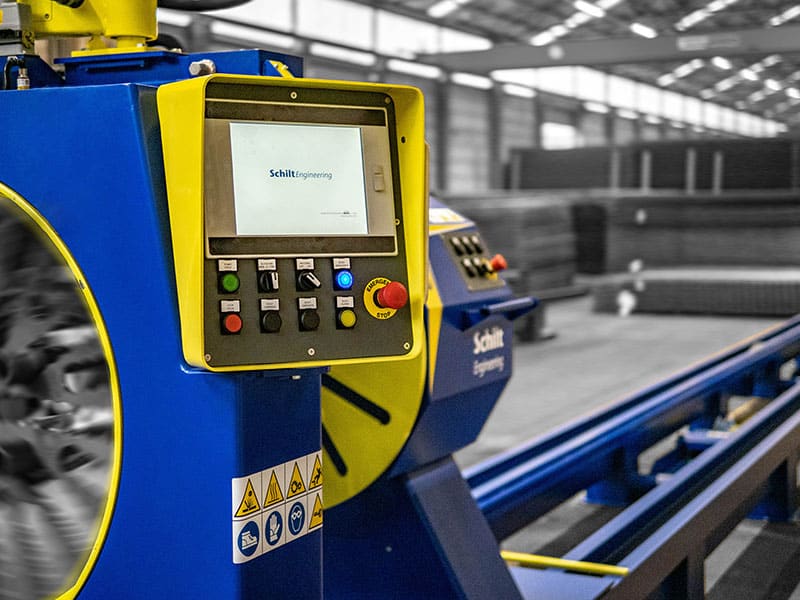
Pile cage welding machine for small-diameter piles and micropiles.
The SLP 650 welds reinforcement cages from Ø100 to Ø650 mm, up to 18 m: the cages that go into CFA, small bored piles and screw displacement piles — and into micropiles where the design calls for a cage.
Built for the cages that are lowered into fresh concrete.
Below Ø300 mm most micropiles are reinforced with a steel tube or a single bar. The volume work in this class is the Ø300–650 mm cage for CFA and screw displacement piles — placed into fresh concrete, where a cage that is not stiff and straight becomes a problem at the rig.
CFA and auger-cast piles
Cages plunged into fresh concrete after the auger is extracted. The welded spiral keeps its pitch and the cage its geometry during insertion.
Small-diameter bored piles
Series cages for residential, logistics and industrial foundations, produced to the project drawings.
Screw displacement piles
Olivier- and Atlas-type piles, where the cage follows the concrete into the displaced bore.
Micropiles with cage reinforcement
Where the design specifies a small cage instead of a tube or a single bar, the SLP 650 welds it in series.
Small cages punish variation. The PLC removes it.
On a Ø350 mm cage every crossing is close to the next. Weld triggering, weld time and welding parameters are managed by the PLC, so every crossing is welded the same way — welds your customer can assess against EN ISO 17660.
How the PLC runs every weld →Constant weld time
Independent of rotation speed, held by the PLC on every crossing.
Stored recipes
Cage programmes saved and recalled; barcode integration loads the job.
One torch, option for two
A second MIG torch can be added to shorten the welding cycle on every cage.
Guided format changes
The reference-scale positioning disc and the PLC guide the operator from one cage type to the next.
One measured example, with all its conditions.
Output depends on diameter, number and size of bars, spiral and pitch — so instead of a slogan, here is one configuration measured on a customer's production floor.
9 min
One finished cage: Ø350 mm (14″), eight #8 bars (Ø25 mm), 16 m (52 ft), Ø12 mm spiral at 100 mm pitch
~16
Cages of that configuration per 8-hour shift
A specific case, not a general figure. Send your cage drawings for an estimate on your configuration.
SLP 650 — technical data.
Cage diameter
100–650 mm (3.9″ to 25.6″)
Cage length
12, 18 m (39, 60 ft)
Max. cage weight
3 t (6,600 lb)
Longitudinal bar Ø
10–25 mm (32 mm on request)
Wire spiral Ø
6–12 mm
Spiral pitch
50–500 mm (1.9–20″)
MIG torches
1, second torch available as an option
Installed power
9 kW
In a rebar shop or next to the rig.
The SLP 650 is the compact machine of the series, with its own frame sized for small cages. It installs in a rebar fabrication shop or in a piling contractor's yard, in the plant or directly on site — reducing transport of finished cages.
Operators are trained on site by EMG, and the machine is supported online for diagnostics and remote assistance.
Questions we hear from buyers.
Can the spiral be welded to the bars under EN ISO 17660?
The standard qualifies your welding procedure, not a machine. What the SLP 650 gives you is a weld executed with set, repeatable, PLC-controlled parameters — the basis on which a procedure is qualified and kept under control. We can walk you through how customers approach it.
Which bar and spiral diameters can it weld?
Longitudinal bars 10–25 mm (32 mm on request), spiral 6–12 mm, pitch 50–500 mm. If your cage design sits outside these ranges, ask: the next class up is the SLP 1200.
How many cages per shift?
It depends on diameter, bars, spiral and pitch. The measured example above — Ø350 mm, eight Ø25 mm bars, 16 m — ran at one cage every 9 minutes. Send your typical cage and we reply with an estimate for your configuration.
Do I need the second torch?
No. The SLP 650 welds with one MIG torch; the second torch is an option that shortens the cycle on every cage. Whether it pays back depends on your volumes — part of the quotation conversation.
Answers in brief. For your cage drawings and production targets, an engineer replies with the full picture.
