Data center campuses are going up on every continent, and every one of them stands on piles. The reinforcement cages inside those piles are turning into a production problem that hand-tying crews struggle to solve alone.
Take a foundation contractor that has just put two pile cage machines to work. The lines are running and the first cages are going out. A few months later a data center campus starts to take shape not far away. Once the contract is signed, two more machines arrive and go straight into double shifts, building cages for that project alone.
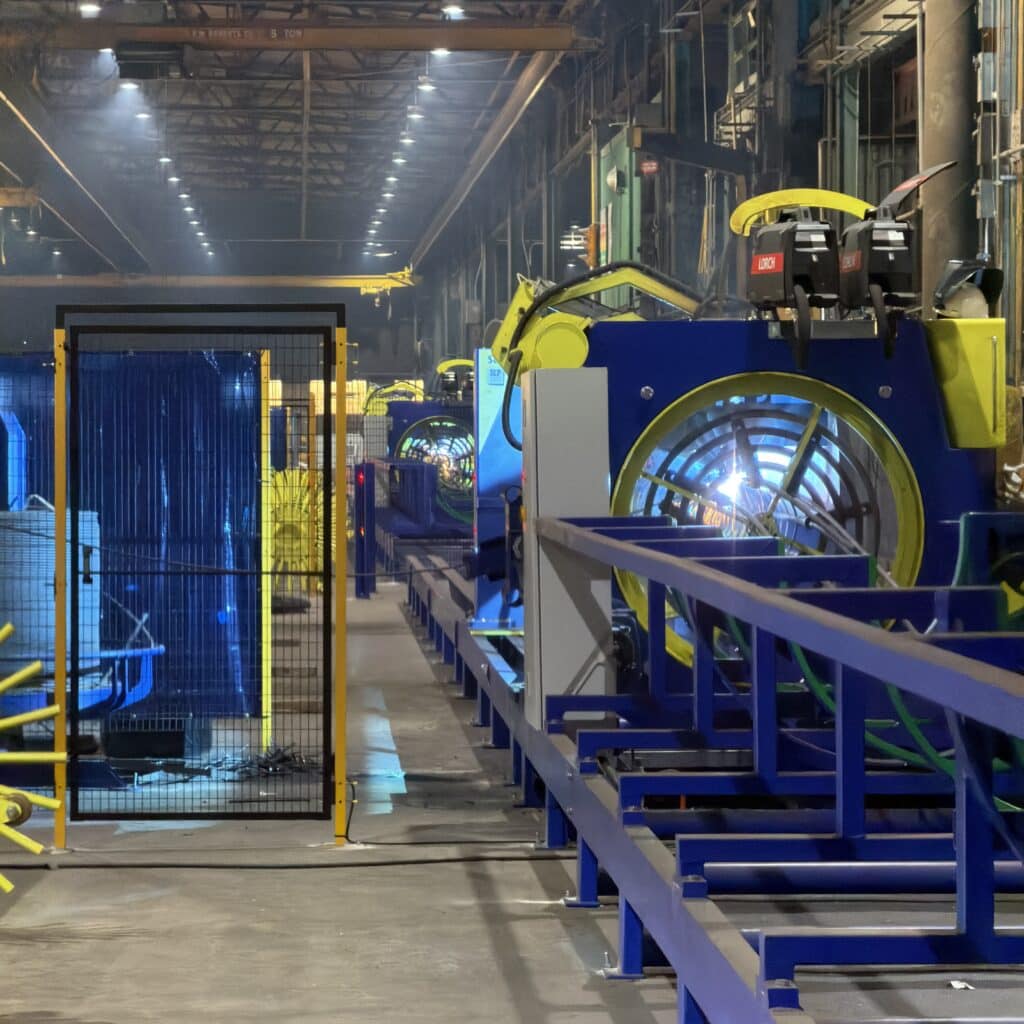
Scenes like this have become familiar at EMG, which designs and builds the SLP series in partnership with Schilt Engineering and pioneered the design of large pile cage machines able to produce heavy cages of more than 30 t and up to 3 m in diameter. They say a good deal about how the data center build-out is reshaping foundation work, and about where the pressure lands.
A build-out on every continent
The scale is hard to overstate. At the end of September 2025, BloombergNEF counted more than 23 GW of data center capacity under construction worldwide, on 831 sites. The money behind it keeps growing: JLL expects the four largest hyperscalers to spend $725 billion in 2026, 77% more than the year before.
In Europe, the shape of the market is changing as much as its size. According to JLL’s mid-year report, reported by DatacenterDynamics, greenfield sites now make up 39% of the region’s future pipeline, up from 8% over the past three years. New land means new foundations. Asia Pacific has a record 26.5 GW in its development pipeline, according to Cushman & Wakefield, with capacity under construction in Johor, Malaysia, up 91% and Sydney’s pipeline up 65%. In the Gulf, regional conflict has slowed completions, but JLL describes the projects as “deferred, not dropped” and still expects Middle East capacity to roughly quadruple by 2030.
North America remains the largest single market, with about three quarters of the capacity BloombergNEF tracked. But the foundation problem it faces is the same one contractors are meeting in Frankfurt, Johor and Sydney.
Heavy buildings, deep piles
Data centers are unforgiving structures. In a recent cover story, Pile Buck Magazine notes that individual columns often carry well over 1,000 kips, roughly 450 tonnes, and that the equipment inside tolerates very little settlement. On soft clays, loose sands or high water tables, those loads go down through piles. Where vibration limits rule out impact driving, the choice usually falls on drilled shafts and CFA piles, both of which need a reinforcement cage.
The magazine lists rebar cages among the steel items that “need to arrive on time and meet the project specifications”, and warns that supply tightens when several large projects compete for the same materials. Foundation packages on these jobs carry little float. When piling slips, structural steel and equipment installation slip with it, and the cage yard finds itself on the critical path.
Where hand-tying runs out
Many pile cages are still tied by hand, bar by bar, with thousands of wire ties on every cage. Good crews do it well. The trouble is that their output rises only with their numbers, and skilled labor is exactly what the build-out has used up. Associated Builders and Contractors estimates that US construction alone must find 349,000 new workers in 2026, and its chief economist points to AI data centers as one of the reasons.
Volume is not the only issue. Spacing and spiral pitch drift from crew to crew and from morning to evening. A long cage lifted from horizontal to vertical can rack when tied joints slip, so yards add stiffeners and bracing.
Welding would help, and experience in Europe and around the world proves it. Welded pile cages are established practice in many countries, and in Europe the welding of reinforcing steel has its own standard, EN ISO 17660. Where engineers still hesitate, what they resist is a weld made by hand whose time and current nobody recorded.
Welding under control
That last point is where a pile cage machine changes the conversation. On EMG’s SLP machines, weld triggering, weld time and welding parameters are set in the PLC and stored as presets. Each weld is checked against a preset range, and the machine raises an alert when a value falls below it. A weld made this way can be tested once and then repeated thousands of times, which gives the engineer of record something concrete to sign. American customers have run their own weld tests on SLP cages, with EMG’s engineers supporting them.
The rest follows from the same logic. Cage recipes hold diameter, bar layout and spiral pitch, and barcode labels and data export give each cage a record of its own. The range covers cages from 100 mm to 3,000 mm in diameter (4 to 118 inches) and up to 24 m long, with bars up to 40 mm.
For a contractor facing a campus built in phases, it also changes the arithmetic of capacity. Output is planned per machine rather than per crew, so it can be added in steps as the phases arrive. Two machines become four, and the new pair runs double shifts on the data center while the first two carry on with everything else.
Sources
- Pile Buck Magazine, Vol. 42 No. 4 (2026), Deep Foundations for Data Centers: Challenges, Opportunities, and How to Compete
- BloombergNEF, AI data center build advances at full speed: five things to know (data as of September 2025)
- DatacenterDynamics, JLL: FLAPD on track for record data center growth year while Middle East pipeline is paused (August 2026)
- Data Center Knowledge, APAC data center pipeline surges as AI pre-leasing tightens supply (August 2026)
- NCCER, Report: construction needs 349K new workers in 2026 (February 2026, ABC data)